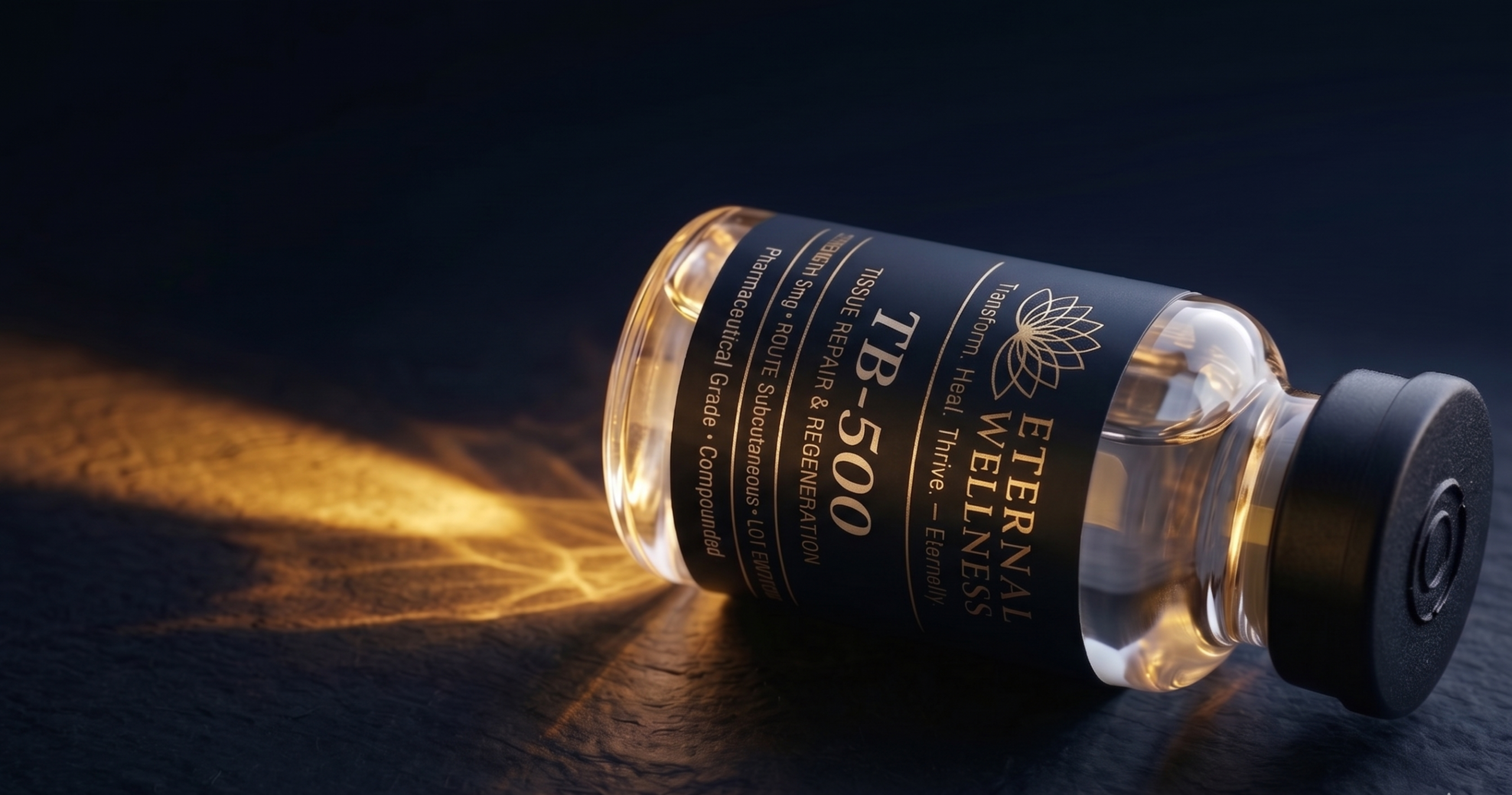
Your body knows how to heal.
TB-500 removes what's stopping it.
A synthetic peptide of the naturally occurring protein Thymosin Beta-4. TB-500 upregulates actin, drives cell migration to injury sites and accelerates the repair of muscle tears, connective tissue and chronic injuries that have simply stopped responding to rest.
You've done the rehab.
The injury still isn't right.
Most people researching TB-500 aren't strangers to hard work or discipline. They are athletes, high-performers, and active individuals who have done everything right — and whose bodies have simply hit a biological ceiling on repair.

You have a muscle tear or strain that flares the moment you push past 80%. You rest it, it settles — you train, it goes again. The cycle has been repeating for months.
You're dealing with stiffness and restricted range of motion from scar tissue built up over years of hard training. Your biomechanics are compensating in ways you can feel but can't fully fix.
You're recovering from surgery and want the tissue to remodel correctly — not form dense, inflexible adhesions that will compromise your movement for years.
- Recurring muscle strains that never seem to fully knit
- Loss of flexibility and range that hasn't responded to physio or stretching
- Chronic inflammation in joints, tendons or muscle belly
- Post-surgical recovery that's progressing slower than expected
- Micro-tears accumulating faster than your body can repair them
- A sense that your body is simply not recovering between sessions anymore
Rest tells the injury to wait. TB-500 tells the body to rebuild. Those are not the same instruction.
What TB-500 actually is.
Not marketing language. Not a supplement label. The biology — explained clearly.
TB-500 is a synthetic version of a 43-amino acid peptide fragment derived from Thymosin Beta-4 — a protein found in virtually every cell in the human body, with the highest concentrations at sites of active repair and regeneration.
Its primary biological role is the regulation of actin — the structural protein that forms the scaffolding of your cells. When tissue is damaged, Thymosin Beta-4 is released locally to upregulate actin polymerisation, enabling cells to migrate to the injury site and rebuild the structural matrix.
TB-500 is the synthetic, bioavailable peptide that delivers this signal systemically. Unlike BPC-157 — which is highly localised and excels at angiogenesis — TB-500 is a whole-body signal. It circulates, finds inflammation, and initiates repair at every site that needs it simultaneously.
The result is not just faster healing. It is more complete healing — with less scar tissue formation, better tissue quality and restored flexibility that rest alone cannot produce.
Three things TB-500 does
that rest simply cannot.
Written so a non-scientist understands it in one read. No jargon without translation.

Actin is the structural protein that forms the physical framework of your cells. When tissue is torn or damaged, new cells need actin to build the repair structure. TB-500 directly upregulates actin production — giving your body more of the raw material it needs to rebuild quickly and with better structural integrity than scar tissue formation allows.
Repair cells need to physically travel to the damaged tissue. In a healthy, young body this happens rapidly. With age, chronic inflammation or systemic overload, this migration slows significantly. TB-500 accelerates cell migration — getting the right biological tools to the right location faster, which is the fundamental bottleneck in most slow-healing injuries.
Chronic inflammation is both a symptom of injury and a barrier to repair. High inflammatory load at a tissue site actively inhibits the healing cascade. TB-500 modulates the local and systemic inflammatory environment — not by suppressing it pharmacologically like a corticosteroid, but by supporting the body's own resolution pathway. The repair signal can finally be heard through the noise.
What TB-500 actually feels like.
Not a feature list. The felt experience of a body that's finally healing the way it should.
Most people with chronic injuries aren't failing to rest — they're failing to resolve the underlying repair deficit. TB-500 addresses the biological environment that's keeping the cycle in place. The injury doesn't just settle — it actually closes. That distinction matters enormously to anyone who's been managing the same site for months.
"I'd been nursing the same hamstring for eight months. Two weeks in, I trained at 90% for the first time without bracing for it to go. That hadn't happened in a year." — Client, 36
Scar tissue is the body's emergency patch — functional but rigid. Over years of hard training, it accumulates and progressively restricts movement in ways that can't be stretched away. TB-500 supports the remodelling of existing scar tissue and reduces new adhesion formation during healing — restoring flexibility that physio and manual therapy alone have a ceiling on.
"My hip flexor had been restricting my gait for two years. It started moving like it used to within six weeks. My physio couldn't explain it. I didn't tell him." — Client, 44When your systemic repair rate can keep pace with training demand, volume becomes a tool rather than a liability. High-output athletes find that micro-tears resolve between sessions rather than accumulating. The body stops falling behind. You stop managing damage and start building capacity.
"Six training sessions a week used to leave me limping by Thursday. Now I'm recovering between sessions like I did at 28." — Client, 41The quality of tissue formed during post-surgical healing determines functional outcomes for years. TB-500 supports the formation of more organised, elastic, less adhesion-prone tissue during the remodelling window — the narrow period where intervention has the most lasting impact.
"My surgeon said the tissue quality at eight weeks was what he'd expect at sixteen. I wasn't going to argue with that." — Client, 39For people carrying chronic, low-grade inflammatory load — from old injuries, high training volumes or metabolic stress — TB-500's systemic anti-inflammatory signalling has a measurable quality-of-life effect. Morning stiffness reduces. Joints feel easier to move through. The body stops feeling like it's constantly in a state of low-level defence.
"I stopped waking up feeling like I'd been hit by a truck overnight. That alone was worth it." — Client, 48Six profiles.
See if you recognise yourself.
TB-500 isn't for everyone. These are the people it's typically most appropriate for — and where it isn't the right starting point.

You have one injury — maybe two — that has never fully resolved. You've done the physio, the rest, the massage, the anti-inflammatories. It settles, it returns. The biological repair ceiling has been reached with conventional approaches and the injury needs a different signal entirely.
You've had surgery on a tendon, muscle or joint and you want the tissue that forms during the remodelling window to be as organised, elastic and functional as possible. The 6–12 weeks post-surgery is the window where TB-500 has its greatest long-term impact — and most people don't know this window exists.
Years of accumulated micro-trauma and scar tissue have progressively restricted your range of motion. Your biomechanics have quietly compensated in ways that increase injury risk elsewhere. TB-500 addresses the tissue quality driving that restriction — not just the symptom of stiffness.
You have a severe, complex or chronic injury and you're already researching BPC-157. You want to deploy the most comprehensive dual-pathway recovery protocol available. BPC-157 builds the blood supply; TB-500 provides the systemic scaffolding and cell migration. Together, they address the injury from both angles simultaneously.
CrossFit, endurance sport, combat sport — you subject your body to training loads that consistently outpace natural repair rates. You use TB-500 proactively to keep systemic inflammation low and ensure micro-tears resolve between sessions before they accumulate into structural injuries.
Decades of hard physical use have left your muscles and fascia dense, stiff and functionally restricted. You're not injured in the acute sense — you're structurally compromised in the chronic sense. TB-500 works at the tissue level to restore the elasticity and quality that accumulated damage has taken away.
TB-500 may not be appropriate for people with active cancer or certain proliferative conditions, those on specific medications that interact with repair signalling pathways, individuals with no genuine tissue injury or inflammatory condition driving the interest, or those who are pregnant or breastfeeding. If you're exploring TB-500 primarily for performance enhancement rather than repair, Peter will have an honest conversation with you about whether it's the right starting point — and what is. A full health screening determines fit before any protocol is designed.
Ask us if this belongs in your repair protocol.
Leave your name and email. Your TB-500 interest will be sent to our specialist team and they will reach out shortly.
No instant checkout. No automated protocol. A real review before anything is recommended.
TB-500 is one of the most faked peptides
in the grey market.
A degraded peptide isn't just weaker — it's a different molecule. What you inject needs to be exactly what the label says. Here's what pharmaceutical-grade actually means.
A degraded peptide isn't just weaker — it's a different molecule. What you inject needs to be exactly what the label says. Here's what pharmaceutical-grade actually means.
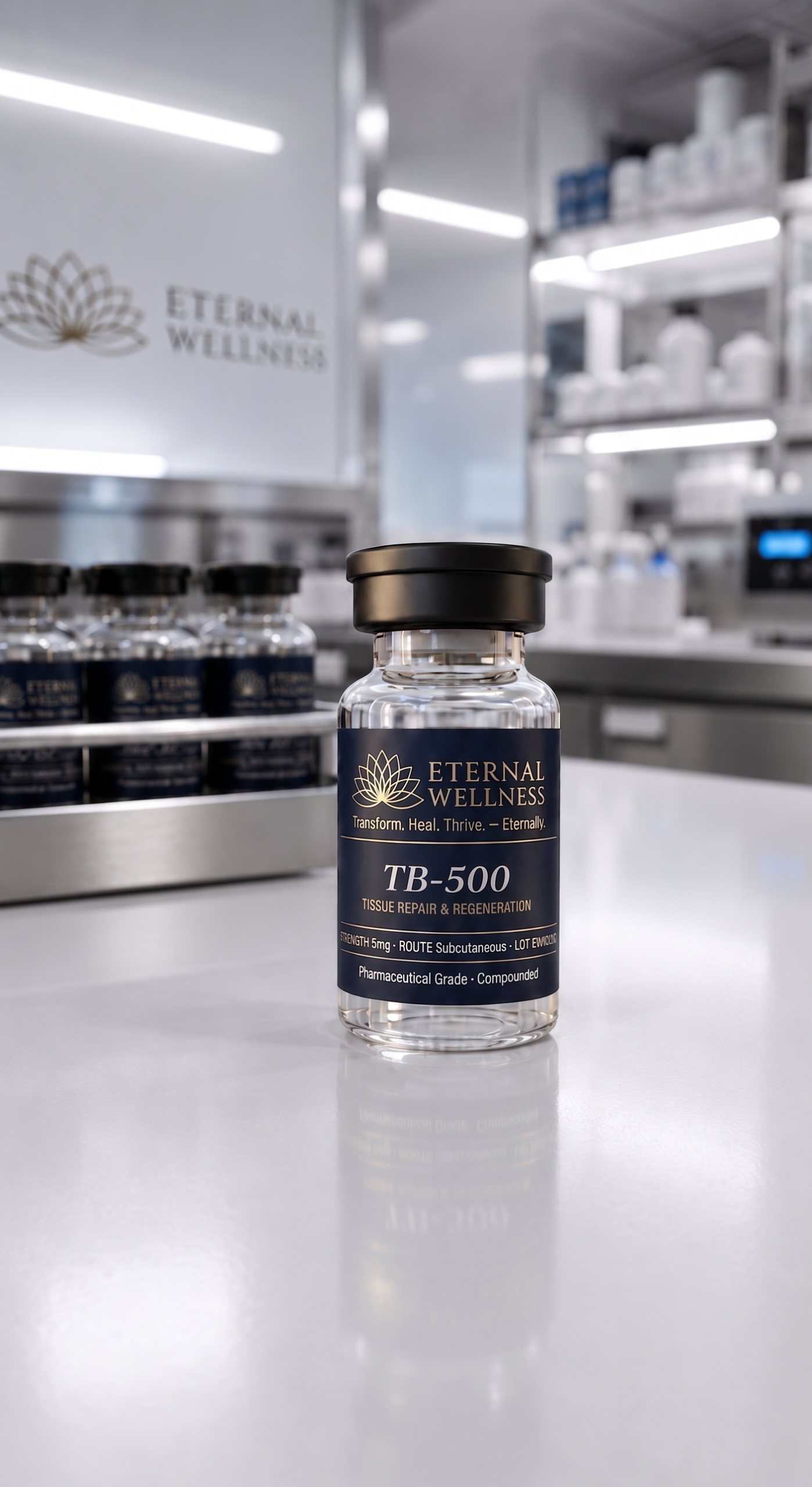
The peptide grey market has a serious quality problem — and TB-500 is one of the most frequently substituted and degraded compounds available online. Underground labs regularly sell heavily degraded product, substitute cheaper compounds, or fail to maintain cold-chain integrity that TB-500's molecular structure requires. A degraded peptide injected into your system isn't just ineffective — it's an unknown biological variable.
Trevor ensures the nutritional environment supports the repair signal — protein targets, micronutrient framework and any supplement considerations that determine how well your cells can actually execute what TB-500 initiates. I coordinate the whole experience from first contact through to aftercare.
Understand why pharmaceutical-grade sourcing, third-party testing, and specialist review matter before any protocol begins.
Read: Why Quality Matters →Tissue doesn't rebuild overnight.
Here's what the process actually looks like.
TB-500 isn't a painkiller — it's a repair signal. The timeline below reflects what most clients experience when the protocol is designed correctly and the nutritional environment supports it.
Peter reviews your full injury history, bloodwork, medications and training load before designing your protocol. Cycle length, dose and frequency are specific to your injury type and severity. If a BPC-157 stack is appropriate, Peter identifies this here and designs both protocols together. The consultation form is where this starts — and it only takes a few minutes.
The first changes are often systemic rather than local. Chronic inflammatory load begins to reduce. Morning stiffness eases. The injured site feels less reactive — not because pain signals are being blocked, but because the inflammatory environment that was maintaining that sensitivity is beginning to resolve. Mobility at the site typically starts to expand toward the end of this phase.
This is the phase where the rebuilding becomes tangible. Clients typically report being able to load the injured tissue at levels that weren't possible before. Range of motion expands noticeably. The injury stops reactivating at the threshold where it previously always flared. For post-surgical clients, tissue quality at this stage often exceeds standard timelines — with less adhesion and better functional pliability.
Peter reviews your outcomes at the end of the first cycle. For fully resolved acute injuries, a maintenance rest period is typical. For chronic or complex injuries, a second cycle or transition to a complementary compound may be recommended. The goal is not indefinite protocol dependency — it is a body that has genuinely rebuilt the structural deficit and can sustain performance without ongoing peptide support.
Rest is passive. TB-500 is active. One tells the injury to wait — the other tells the body to close it. That distinction is everything if you've been waiting long enough.
What changes when the body
finally gets the right signal.
Real outcomes from real protocols. Names withheld for privacy. Results are individual and depend on health history, injury type, protocol design and commitment to the full programme.
"Eight months of the same hamstring. Physio, rest, dry needling, everything. It would settle for two weeks and go again the moment I pushed it. Three weeks into the TB-500 protocol I trained at 90% for the first time without bracing myself for it to pull. Six weeks in I was back to full training. That injury had cost me an entire season."
"ACL reconstruction at 43. I started the TB-500 protocol at week six post-surgery — Peter specifically timed it for the remodelling window. My physio commented at week twelve that my range of motion and tissue compliance were tracking four to six weeks ahead of what he normally sees. My surgeon said the same thing at my three-month check. I don't think that's a coincidence."
"I was training six days a week and by Thursday my body felt like it was falling apart. Not one specific injury — just everything aching, every session costing more than the last. The TB-500 cycle changed the recovery equation completely. I'm training the same volume and actually feeling better by the end of the week than I did at the start. That's never been true before."
A powerful repair signal
deserves an honest conversation first.
TB-500 has an excellent safety profile in available research. But the right compound for the wrong person is still the wrong decision. Here's what we take seriously before any protocol begins.
Peter reviews your complete health history, current medications, bloodwork and injury picture before any protocol is designed. This is the foundation of a safe and effective outcome — not a formality. If TB-500 is not right for you, Peter will tell you directly and recommend what is. No protocol begins without this step.
TB-500 is not appropriate for people with active cancer or certain proliferative conditions, due to its cell migration and proliferative mechanisms. It may also be contraindicated for those on specific medications that affect repair signalling, or those who are pregnant or breastfeeding. Individual contraindications are identified at the screening stage.
TB-500 does not interact with the hypothalamic-pituitary axis and does not suppress endogenous hormone production. There is no requirement for post-cycle therapy. It can be used alongside existing hormone optimisation protocols without disrupting them — Peter assesses for any individual interactions during consultation.
TB-500 requires cold-chain integrity and precise molecular stability to function as intended. Underground lab sourcing frequently produces degraded, substituted or bacterially contaminated product. A compound that operates on cell migration and proliferative pathways must be sourced to pharmaceutical standards — anything less is an unknown variable injected directly into your system.
TB-500 is a research compound. All information on this page is educational and does not constitute medical advice. Individual results vary. All Eternal Wellness Center protocols begin with a full clinical health screening conducted by our peptide and hormone specialist. Eternal Wellness Center does not recommend or condone self-administration without clinical oversight.
The questions we get asked
every single week.
Answered plainly. If something isn't here, ask us directly — we'd rather you have the right information than make a decision on a gap.
The injury has had long enough.
Let's give your body a different signal.
The first step is our free consultation form. It takes a few minutes and gives Peter everything he needs to assess whether TB-500 is right for you — and what your protocol would actually look like. No obligation. No template answers. Just a real clinical assessment of your picture.
Free consultation · Pharmacist-reviewed · No obligation · Pharmaceutical-grade compounds