Ageing is a cellular process.
GHK-Cu tells your cells to rebuild.
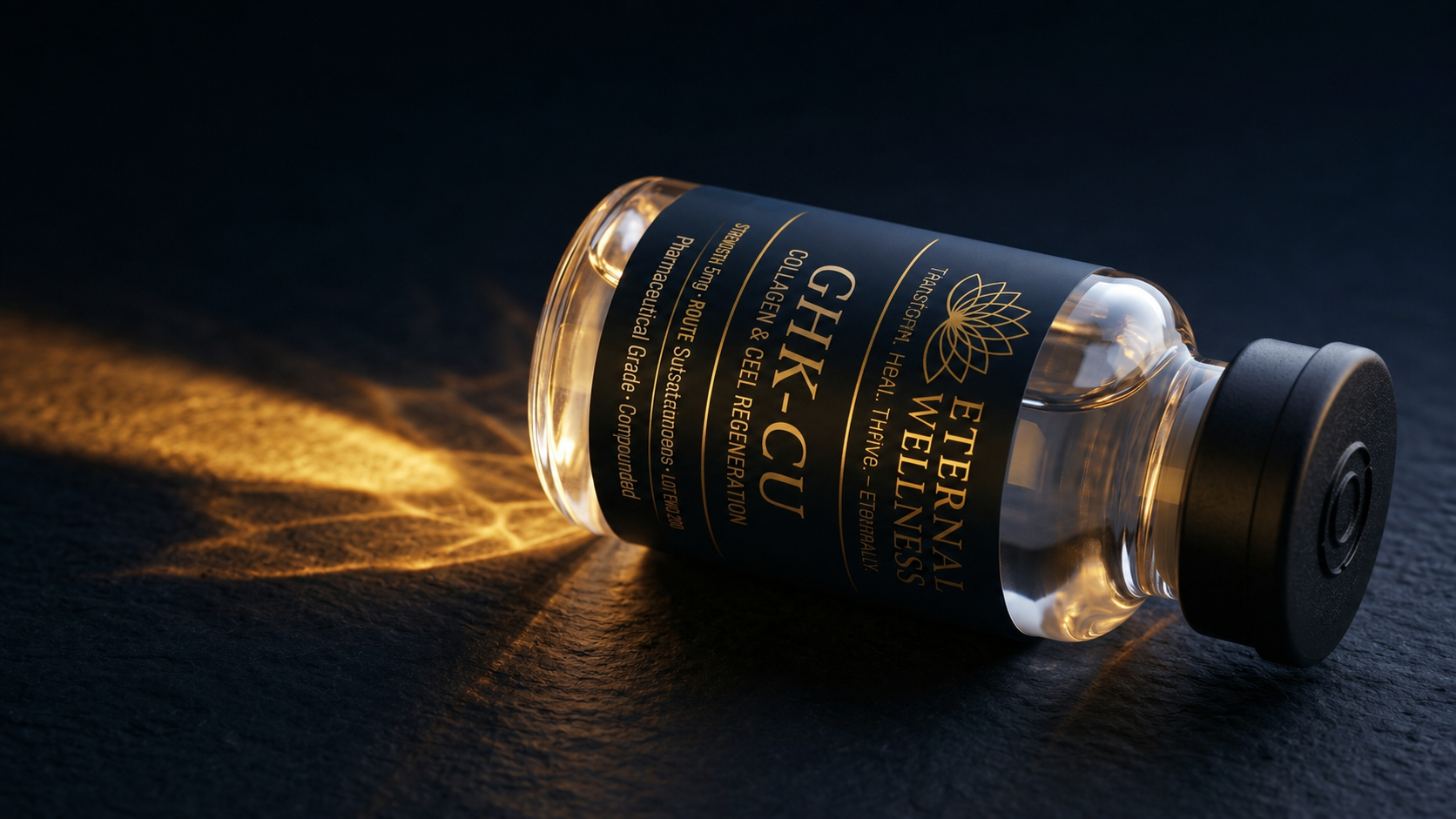
The most studied copper peptide in existence. Explored for systemic collagen synthesis, skin elasticity restoration, hair follicle repair and gene-level biological renewal. When topical treatments stop working, this is what addressing the biology directly looks like.
You're doing the maintenance.
But the mirror tells a different story.
Most people who arrive at GHK-Cu aren't looking for a quick cosmetic fix. They've invested years in their health and appearance — but the structural foundations are quietly shifting. If this resonates, you're in the right place.
You've spent thousands on premium topical serums and collagen supplements. They feel nice. But structurally, your skin keeps losing density and elasticity — because topicals cannot reach deep enough to matter.
You've noticed a distinct change in hair volume. The shedding is increasing, the density is decreasing. Standard supplements aren't touching the follicle at the root level.
Your body's ability to repair itself has slowed. A minor cut, a blemish, a post-procedure scar — all of it takes noticeably longer than it did a decade ago.
- Skin has lost its former density, firmness or elasticity
- Fine lines and texture changes that topicals haven't resolved
- Increased hair shedding or visible thinning at the crown
- Wounds, blemishes or post-surgical scars healing more slowly
- General joint stiffness or a sense of systemic inflammation
- A feeling that your biology simply isn't repairing the way it used to
"You cannot out-moisturise a systemic decline in collagen. GHK-Cu changes the math at the cellular level — from the inside out."
What GHK-Cu actually is.
GHK-Cu — Glycine-Histidine-Lysine bound to copper — is a peptide that occurs naturally in human plasma, saliva and urine. In your twenties, its concentration is high. By your sixties, levels have dropped by more than 60%. That decline maps almost precisely onto the structural changes we associate with ageing skin, slower healing and reduced vitality.
What makes GHK-Cu remarkable — and distinct from almost anything else in the longevity space — is the breadth of its mechanism. It doesn't do one thing. It does many things simultaneously: stimulating collagen production, remodelling scar tissue, activating hair follicles, upregulating repair genes and driving antioxidant defence.
This is not a topical cosmetic ingredient. Administered subcutaneously, it operates systemically — signalling cells throughout the body to behave as if they are younger, less damaged, and more capable of repair.
How GHK-Cu actually works.
Not cosmetic marketing. The biological pathways behind the structural change — explained clearly.
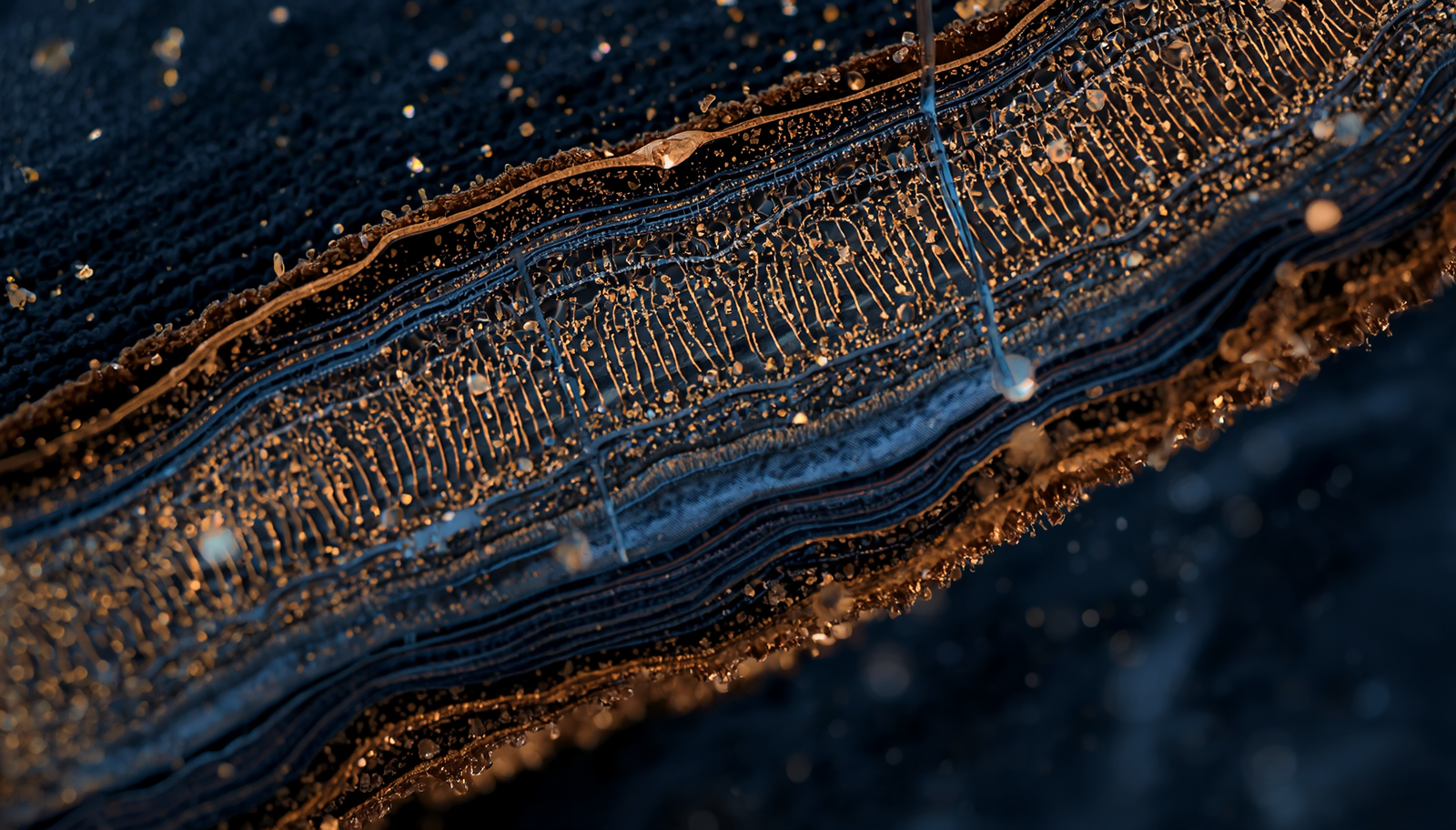
This is the most profound mechanism. GHK-Cu interacts directly at the DNA level — preclinical research shows it modulates the expression of over 4,000 human genes, upregulating repair and regeneration pathways while downregulating inflammatory and decay-associated signals. It is, functionally, a reset toward a younger biological profile.
Topicals push collagen from the outside. GHK-Cu signals the body to massively increase internal production of collagen, elastin and glycosaminoglycans — restoring the biological scaffolding that keeps skin tight, joints resilient and connective tissue functional throughout the body.
GHK-Cu has been shown to enlarge hair follicles and stimulate growth by promoting basal stem cell survival in the follicle bulb. It shifts follicles from the resting phase (telogen) back into active growth (anagen), directly countering age-related thinning and shedding at the biological source.
GHK-Cu activates metalloproteinases — enzymes that break down degraded proteins and scar tissue — to make way for fresh, healthy cellular architecture. This is the mechanism behind its wound healing acceleration and its ability to dramatically improve the appearance of post-surgical and post-procedural scarring.
GHK-Cu supports the formation of new blood vessels, restoring the micro-capillary networks in skin and scalp that decline with age. Tissues that have been slowly starved of oxygen and nutrients — particularly the scalp and dermis — begin to receive the supply they need to repair and regenerate properly.
Copper is a critical cofactor for superoxide dismutase — one of the body's most potent natural antioxidants. By elevating systemic GHK-Cu levels, the body becomes substantially better equipped to neutralise the oxidative stress and free radical damage that drives biological ageing at the cellular level.
What GHK-Cu actually feels like.
This is what happens when you stop painting the surface and start rebuilding the structure.
The shift isn't gradual surface improvement — it's a change in structural quality. Skin that felt thin and fragile starts to feel dense and resilient again. Elasticity returns. The skin doesn't just look better under certain light. It holds its shape. Clients who've spent years searching for the right serum describe it as finally finding the right signal.
"My dermatologist asked what laser treatment I'd had done. I hadn't been in six months." — Client, 48
For those dealing with age-related thinning, the shower drain becomes less confronting. GHK-Cu shifts follicles back into growth phase. It requires patience — hair biology is slow — but clients consistently report that hair feels thicker at the root, shedding reduces measurably, and volume that felt permanently lost begins to return.
"The volume at my crown is returning. It feels fundamentally healthier — not just different." — Client, 44The rapid cellular turnover you had in your twenties comes back. A minor cut, a post-procedure mark, a blemish that used to linger for weeks — the timeline compresses. Post-surgical clients in particular notice a striking difference in how cleanly and quickly tissue remodels and scars fade.
"A burn on my arm healed in roughly a third of the time I'd have expected." — Client, 51Because GHK-Cu is administered systemically, the benefits extend well beyond skin. Clients regularly report a reduction in joint stiffness and a general physical lightness as the body's inflammatory burden decreases. The antioxidant uplift from the copper pathway creates effects that reach further than most people expect when they start a skin-focused protocol.
"I started it for my skin. My knees stopped aching in the mornings." — Client, 53Collagen synthesis doesn't stop at the skin. Tendons, ligaments, cartilage — all benefit from the same systemic signal. Athletes and active clients in their 40s and 50s notice that their connective tissue feels more robust, recovery improves, and the wear-and-tear accumulation that comes with training begins to reverse.
"My joints feel ten years younger. I didn't expect that from a skin protocol." — Client, 46"You cannot out-moisturise a systemic collagen decline. GHK-Cu changes the math at the cellular level."
The profiles we see most often.
GHK-Cu is a foundational longevity and repair compound. It is for people who treat their biology as a long-term project — not a short-term fix.

You understand that topical treatments have a ceiling. You want to address skin elasticity loss, collagen decline and cellular senescence at the structural level — before the damage becomes permanent. You're not reacting to a problem. You're staying ahead of it.
You're seeing increased shedding, reduced density, or visible thinning — and standard topical treatments haven't moved the needle. You need to stimulate follicle stem cells and restore microcirculation to the scalp at a systemic level. Topical minoxidil works on the surface. GHK-Cu works at the biology.
Recovering from an aesthetic procedure, joint surgery or significant tissue trauma. You want to minimise scar tissue formation, accelerate wound closure, and ensure tissue remodels cleanly. GHK-Cu is consistently used in post-procedural protocols for exactly this reason.
You train consistently, eat well, and take your recovery seriously — but your connective tissue, skin and hair are showing the cumulative cost of decades of output. GHK-Cu addresses the structural repair deficit that no amount of sleep or nutrition can fully correct alone at this stage of life.
You're already running a broader health optimisation stack — peptides, hormones, nutraceuticals — and you want to add the compound with the most comprehensive evidence base for cellular and structural renewal. GHK-Cu is frequently paired with Epithalon for a full cellular ageing protocol.
Chronic low-grade inflammation is silently degrading your collagen, your follicles, your connective tissue and your skin integrity. You may not have a formal diagnosis — just a body that feels slower, stiffer and less responsive than it should. GHK-Cu addresses the oxidative and inflammatory environment driving that process.
GHK-Cu may not be suitable for people with active cancer or hormone-sensitive conditions, those with diagnosed copper metabolism disorders (including Wilson's disease), individuals on specific medications that interact with copper pathways, or those who are pregnant or breastfeeding. Peter reviews your complete health picture before any protocol is considered — if GHK-Cu isn't right for you, he will tell you directly and recommend what is.
Ask us if this belongs in your repair protocol.
Leave your name and email. Your GHK-Cu interest will be followed up by our specialists.
No instant checkout. No automated protocol. Suitability is reviewed before anything is recommended.
GHK-Cu is not a skincare ingredient.
It deserves pharmaceutical standards.
The difference between a GHK-Cu protocol that works and one that doesn't comes down to purity, dose, route and clinical context. All four are controlled here.
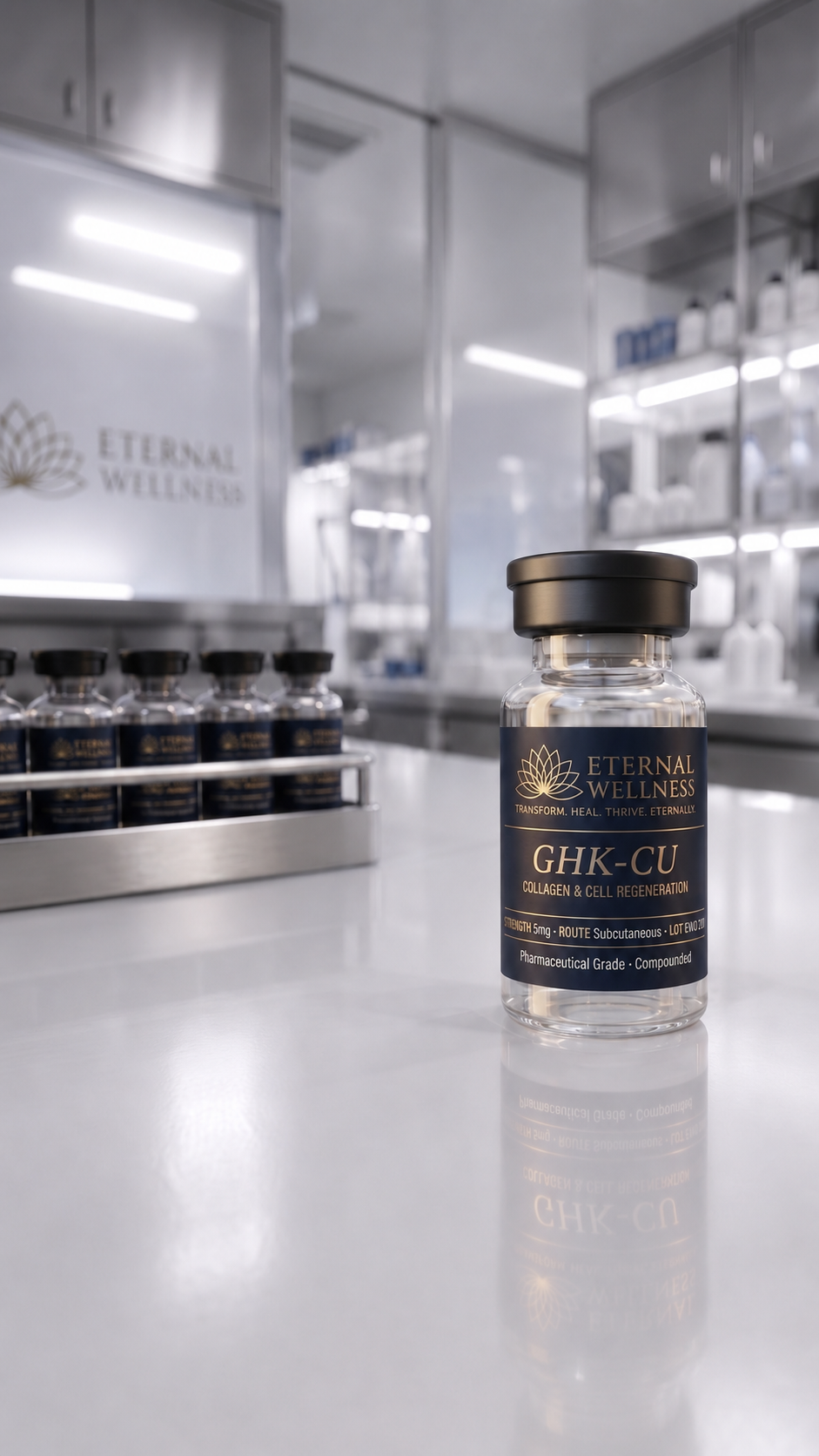
GHK-Cu is widely available in online grey markets — raw powder, unverified vials, undeclared concentrations. A compound that operates on gene expression and copper pathway balance demands a standard of purity and precision those sources cannot provide. The risk compounds with every injection.
At Eternal Wellness Center, Peter designs your protocol from the ground up — based on your health screening, your goals, and the copper-zinc balance in your bloodwork. Trevor supports the nutritional environment that determines how effectively your cells respond to the signal. I keep the entire experience coordinated from first contact through to aftercare.
Understand why pharmaceutical-grade sourcing, third-party testing, and specialist review matter before any protocol begins.
Read: Why Quality Matters →Structure takes time to build.
Here's what the process actually looks like.
GHK-Cu is not a quick fix. It is a biological rebuilding process. The timeline below reflects what most clients experience — honest, realistic, and worth every week.
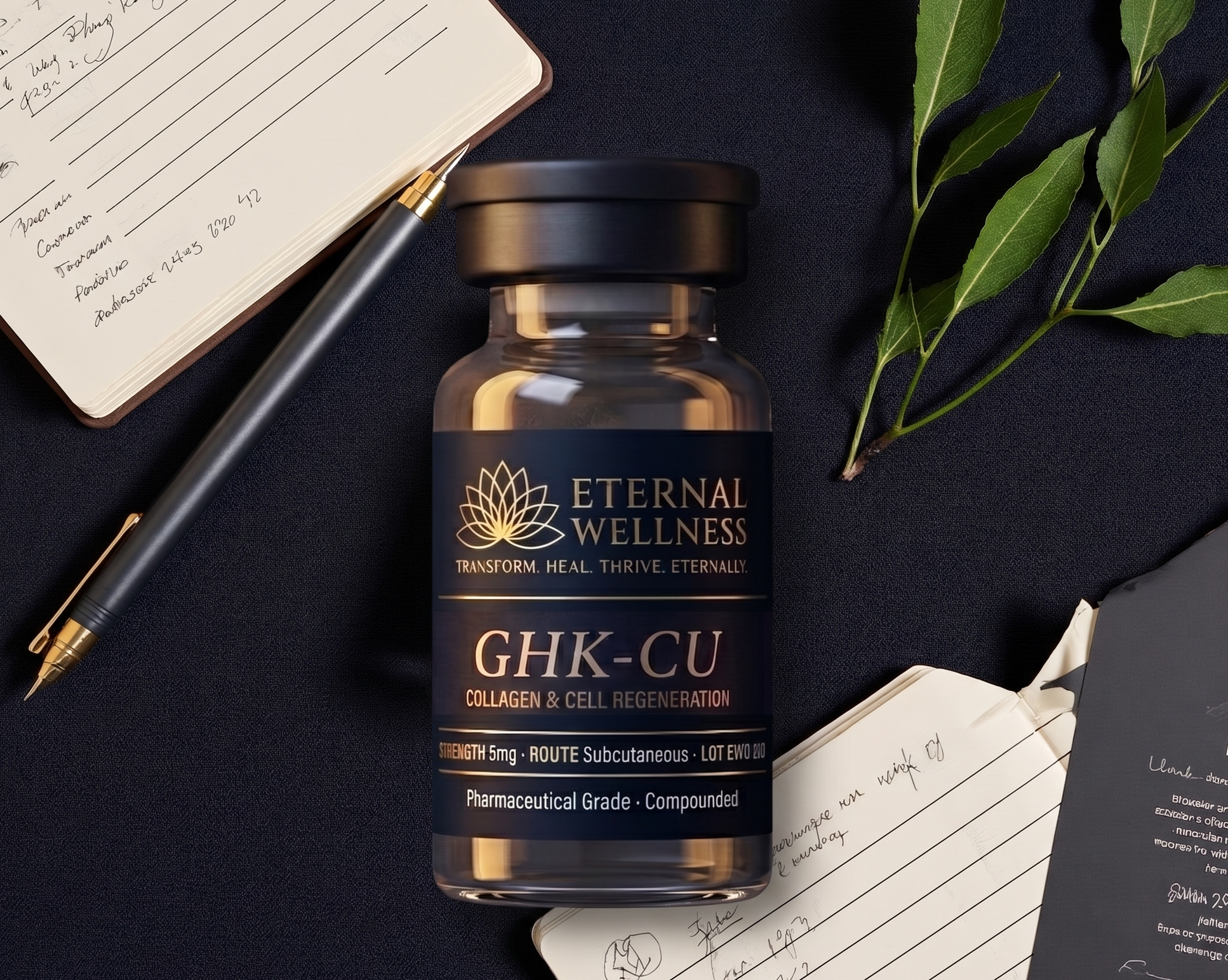
Before anything is dispensed, Peter reviews your full health picture — bloodwork including copper-zinc ratio, current medications, health history, aesthetic goals and structural priorities. Your dose, concentration, injection schedule and cycle length are determined entirely by your biology. The consultation form is where this starts — and it only takes a few minutes.
The first changes clients notice are often not cosmetic — they're systemic. A generalised reduction in joint stiffness. Wounds resolving faster. Skin feeling subtly less fragile at the surface. Inflammation quieting in a way that's hard to name but easy to feel. The gene expression shift has begun — the structural rebuilding follows.
Skin density and elasticity improvements become visible and tangible. Hair shedding noticeably slows. Existing scars begin to remodel. The collagen synthesis that started in week one is now accumulating enough structure to be seen in the mirror. This is typically the phase where clients describe feeling like "something has actually changed" — not just improved.
GHK-Cu's gains are cumulative. Each cycle builds on the structural foundation laid by the previous one. Hair follicle density continues to improve over multiple cycles. Collagen quality — not just quantity — upgrades across the full body. Peter designs your post-cycle plan: maintenance cycle, rest period, or complementary compound pairing. The biology is now working for you long-term.
The collagen your skin needs tomorrow is being signalled today. That's the difference between treating the surface and changing the biology underneath it.
What changes when the structure
starts coming back.
Real outcomes from real protocols. Names withheld for privacy. Results are individual and depend on health history, protocol design and commitment to the full programme.
"I've spent probably $8,000 on premium skincare over the last four years. Some of it is very good. None of it did what GHK-Cu did in eight weeks. My skin feels structurally different — not just hydrated, but dense. My facialist noticed before I said anything. That's when you know it's real."
"I'd tried minoxidil, PRP, biotin, every supplement. The shedding slowed a little but nothing reversed. Three cycles of GHK-Cu in, the volume at my crown is genuinely returning. My hair feels thicker at the root in a way I hadn't felt in years. The process takes patience — Tom was honest about that from the start — but it's working."
"My surgeon was genuinely surprised by how quickly and cleanly my scar was resolving at the six-week check. I'd started the GHK-Cu protocol two weeks post-op on Peter's recommendation. The tissue remodelling was faster and the final scar quality is significantly better than my previous procedure where I wasn't on it. Night and day."
40 years of research.
And we still screen before we dispense.
GHK-Cu has an excellent safety profile across decades of study. But an excellent safety profile doesn't mean appropriate for everyone. Here's what we take seriously.
GHK-Cu raises systemic copper — which over time can suppress zinc if unmanaged. Peter reviews your baseline copper-zinc ratio before any protocol begins. Trevor designs a nutritional framework that supports appropriate mineral balance throughout. This is not a concern that is skipped or assumed — it is actively managed.
GHK-Cu is contraindicated in people with Wilson's disease or other copper metabolism disorders, active cancer or certain hormone-sensitive conditions, specific medication interactions, and those who are pregnant or breastfeeding. Peter identifies these contraindications during your health screening — before any protocol is designed.
Due to the copper ion, GHK-Cu can occasionally cause a mild stinging sensation or localised redness at the injection site — more so than some other peptides. Peter manages this through precise compounding concentrations and specific administration techniques. Most clients report this as minor and transient; it typically reduces across the first few weeks.
A compound operating on gene expression and copper pathway balance requires pharmaceutical purity standards. Impurities in a grey-market GHK-Cu vial don't just affect efficacy — they introduce unpredictable biological variables into a compound that interacts with over 4,000 genes. The risk is not theoretical. It is compounding and cumulative.
GHK-Cu is a research compound. All information on this page is educational in nature and does not constitute medical advice. Individual results vary significantly and depend on health history, protocol design, nutritional status and commitment to the full programme. All Eternal Wellness Center protocols begin with a full clinical screening by Peter, our peptide and hormone specialist. If GHK-Cu is not appropriate for you, Peter will tell you directly.
The questions we always get asked.
Answered clearly. No hype, no deflection.
The structure you want to protect
responds to the right signal.
The consultation form takes a few minutes. Peter reviews your health picture personally. If GHK-Cu is right for you, he designs the protocol from scratch. If it's not, he'll tell you exactly what is.
No obligation. No pressure. Just a clear picture of what's possible for your biology.